

April in Sydney is deceptive. The sun is still warm. The sky is often clear. But the calendar does not lie; and if you manage a strata scheme in Pyrmont, Parramatta, or Penrith, right now is your most important maintenance window of the year.
This is Crunch Time.
March 2026 was drier than average across Greater Sydney. That sounds like good news. It is not. Dry weather means leaf litter has built up without being washed away. Gutters are full. Shared pathways are coated in dust and organic debris. Then May arrives, and Sydney’s early winter storms do not ask for permission.
This guide is written for working strata managers. It covers the risks that matter, the reforms you need to know, and the practical steps to take during April and May.
The Danger of ‘Leaf Drop’ (Fire, Flood, and Biofilm)
Autumn leaf drop creates three separate risks for Sydney strata schemes: fire from dry organic build-up, flooding from blocked drains, and slip injuries from biofilm on pathways. Each risk is manageable, but only if you act before the first heavy rain.
Fire Risk: Dry Leaves in Garden Beds
Dry leaf litter in garden beds against a building’s perimeter is a fire hazard that NSW Fair Trading and insurers increasingly scrutinise. A single cigarette butt near a dry mulch bed is all it takes.
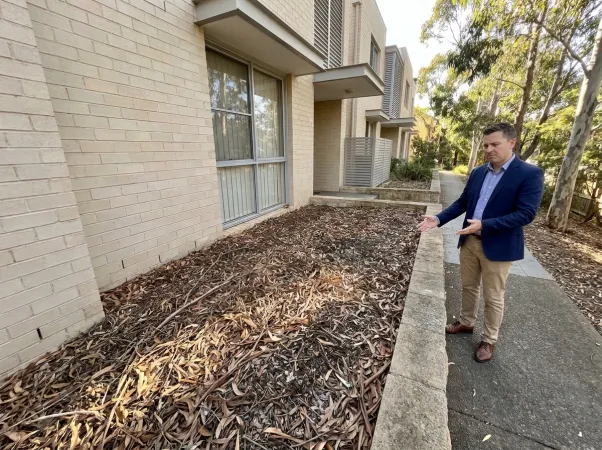
Sydney’s autumn is still warm. October through March has left leaf matter dry and compacted in garden beds, especially in north-facing schemes in suburbs like Baulkham Hills or Castle Hill. Strata managers with townhouse-style complexes need to clear these beds now — before cooler nights create false confidence that fire risk has passed. It has not.
| Leaf Litter Risk | Season of Peak Danger | Recommended Action |
| Fire (dry beds) | March–May | Clear beds; maintain 500mm clearance from structures |
| Flooding (blocked drains) | May–August | Inspect and clear all stormwater grates weekly |
| Slip injury (biofilm) | April–June | Pressure wash paths; apply non-slip treatment |
| Mould (shaded areas) | May–September | Clear debris; allow airflow to pavers |
Flood Risk: Wet Leaves Blocking Drains
Blocked stormwater drains are the leading cause of internal flooding in Sydney strata schemes during winter. A single mature plane tree can shed enough leaves in two weeks to block every grate in a medium-density complex.

Sydney’s plane trees — common in inner-west suburbs like Leichhardt and Glebe — are vigorous shedders. When wet leaves mat down over a stormwater grate, water backs up fast. It finds the next lowest point, which is often a basement carpark or a ground-floor unit.
According to strata insurance data reviewed by property managers in NSW, water ingress from blocked drains is consistently in the top three claims categories for Sydney residential schemes each winter.
Clear your grates now. Then inspect them again after the first heavy rain in May.
The ‘Invisible’ Slip: Biofilm on Common-Area Paths
Biofilm is a thin, slimy film that forms when morning dew mixes with crushed organic matter on a hard surface. Think of it like an invisible ice rink on your paved walkway — except it forms overnight and your residents do not see it coming.
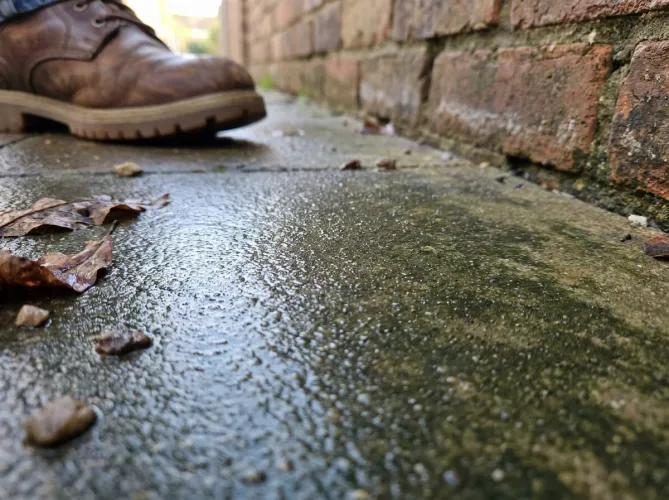
Biofilm is not visible to the casual eye. It forms in shaded spots — under trees, beneath overhanging balconies, along the south-facing sides of buildings in suburbs like Newtown or Randwick. The combination of morning dew and decomposing leaf material creates a bacterial film that dramatically reduces friction on stone, concrete, and pavers.
For a strata manager, this is not just a maintenance issue. It is a legal liability issue. Under NSW common law, a body corporate owes a duty of care to residents and visitors using common areas. A slip injury on an unmaintained pathway has led to successful claims against strata schemes in the NSW Civil and Administrative Tribunal (NCAT).
The fix is straightforward: pressure wash affected areas, then apply a penetrating non-slip sealant.
Pressure Washing: Protection, Not Just Beauty
Pressure washing in autumn removes tannins — natural dyes released by rotting leaves — that permanently stain Sydney sandstone and bluestone. It also prevents the mould colonies that form under wet leaf matter during winter. This is protection, not housekeeping.
Tannins are the natural compounds that give tea its dark colour. When autumn leaves decompose on a paved surface, they release the same compounds. Over time, those tannins soak into porous stone — the kind used extensively in older strata schemes in the Eastern Suburbs, the Inner West, and the Lower North Shore.
By late May, those stains are locked in for the season. By spring, they are effectively permanent without professional chemical treatment.
| Surface Type | Tannin Stain Risk | Recommended Wash Method |
| Sydney sandstone | Very High | Low-pressure hot wash with pH-neutral cleaner |
| Exposed aggregate concrete | Medium | Medium-pressure rinse; re-seal annually |
| Bluestone pavers | High | Low-pressure wash; avoid acid-based cleaners |
| Rendered walls | Low–Medium | Soft brush + rinse; check for mould post-wash |
| Timber decking | Medium | Specialised deck cleaner; re-oil post-wash |
Beyond staining, wet leaf matter sitting on a surface through winter becomes a mould nursery. Mould spreads from paving into adjacent rendered walls. It then works into expansion joints and eventually into waterproof membranes. What starts as a $400 pressure wash job becomes a $12,000 waterproofing repair.
Sydney’s strata maintenance professionals consistently recommend an autumn pressure wash as the highest-return single maintenance activity of the year. The cost-to-risk ratio is simply unmatched.
Term 2 Prep: Safety for Schools and Childcare
Sydney schools return to full Term 2 capacity from late April. This means strata schemes near schools, childcare centres, and family-dense suburbs must have slip-proofed entryways and clean common areas before daily foot traffic surges; especially in morning dew conditions.
Term 2 in NSW began in late April 2026. Suburbs like Homebush, Burwood, and Ryde see significant increases in pedestrian traffic around strata-managed apartment blocks and mixed-use developments as school drop-offs and pick-ups resume.
Morning dew conditions peak in May. A parent carrying a child across a leaf-covered pathway at 8:30am is the exact scenario that produces slip injuries, and liability claims.
| Risk Area | Morning Risk (May) | Recommended Treatment |
| Main entry paths | High — wet + heavy foot traffic | Pressure wash + non-slip sealant |
| Covered walkways | Medium — dew pools at edges | Sweep daily; treat with anti-slip strips |
| Carpark ramps | High — leaves carried in by tyres | Bi-weekly leaf blower; line-marking check |
| Garden-to-path transitions | Very High — biofilm zone | Cut back overhanging plants; wash fortnightly |
If your scheme is within 500 metres of a school or childcare facility, as many Surry Hills, Marrickville, or Chatswood schemes are, prioritise entry and exit path treatment before the second week of May.
NSW Strata Reforms: The 10-Year Capital Works Plan Requirement
As of April 1, 2026, new NSW strata reforms now require 10-year capital works fund plans to use a mandatory government template issued by NSW Fair Trading. Autumn 2026 is the first planning season where this template applies and autumn maintenance costs feed directly into it.
The April 1, 2026 reforms are significant. Under changes to the Strata Schemes Management Act 2015, strata schemes can no longer use internally designed capital works plans. The mandatory template, available through NSW Fair Trading and Business NSW, standardises how maintenance costs are forecast, categorised, and reported to owners.
This changes how autumn maintenance is documented. Costs from pressure washing, gutter cleaning, non-slip treatments, and drain clearing now need to be categorised within the template’s asset-maintenance framework.
For strata managers preparing their first compliant 10-year plan, this autumn is your baseline data collection season. Every job you book from now until June should be documented with:
- The asset category (e.g., common area surfaces, drainage infrastructure, external façade)
- The maintenance type (reactive vs. preventive)
- The contractor quote and invoice
- The expected service life extension
If you have not yet downloaded the new NSW Fair Trading template, do so this week. Experienced strata professionals in Greater Sydney are already advising their committees to treat autumn 2026 maintenance as a capital works audit, not just a seasonal clean.
Quick FAQ: The Strata Manager’s Cheat Sheet
The five most common questions Sydney strata managers ask about autumn maintenance — answered directly, without the jargon. Bookmark this section for your next committee meeting.
Conclusion: The Autumn Safety Action Plan for Sydney Strata
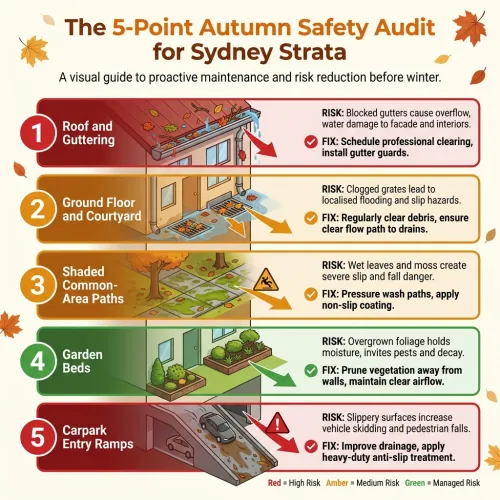
In April, you should be cautious. Sydney’s first serious winter storm is likely to start in May. So, here are the things that you can do in April:
- Audit shaded common-area paths for signs of biofilm — look for a dull sheen on pavers in the morning. If in doubt, walk the path yourself at 7am.
- Inspect every stormwater grate and downpipe outlet in the scheme. Clear any leaf matter by hand and photograph the result for your maintenance log.
- Book a pressure wash for all external common-area surfaces before May 14. Prioritise areas near garden beds and under trees.
- Download the new NSW Fair Trading 10-year Capital Works Fund template and begin categorising your autumn maintenance spend within its framework.
- Check your scheme’s public liability insurance is current and that your maintenance records are up to date — these documents are your first line of defence if a slip or flood claim is made.
The strata schemes that come through Sydney’s winters in the best shape are not the ones that spent the most. They are the ones that were planned in April.
Ready to act? Book an Autumn Property Audit with a Sydney strata maintenance specialist this week.
A qualified auditor will walk your scheme, identify high-risk zones for biofilm, blocked drainage, and tannin staining, and provide a prioritised maintenance schedule aligned with the new NSW Fair Trading capital works template.
Do not let the first storm of 2026 be your audit trigger.